Online advertising is all about purchasing intent

A while ago I dug up this quote from Business Week from 2000:

But how will Google ever make money? There’s the rub. The company’s adamant refusal to use banner or other graphical ads eliminates what is the most lucrative income stream for rival search engines. Although Google does have other revenue sources, such as licensing and text-based advertisements, the privately held company’s business remains limited compared with its competitors’.

We now know what people were missing back then and why Google generates such massive revenues from advertising.  The lesson is that the RPMs* of online ads are directly proportional to the degree** to which the user has purchasing intent.  This is why when you search Google for “cameras” you’ll see ads everywhere (and those advertisers are paying high CPCs), but when you search for “Abraham Lincoln’s birthday” Google doesn’t even bother to show ads at all.

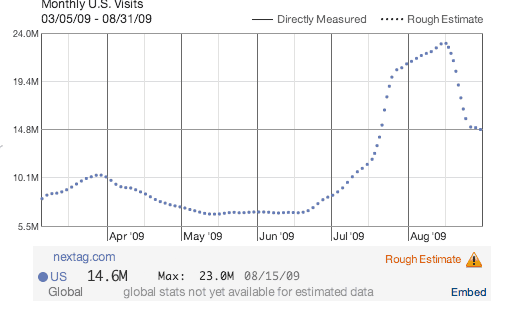
This is also why Nextag will have revenues this year in the ballpark of Facebook’s revenues, even though Nextag gets a fraction of the visits:

Screen shot 2009-09-27 at 9.33.10 AMScreen shot 2009-09-27 at 9.32.46 AM

When people talk about search being a great business model (for, say, Twitter), they should distinguish between search with puchasing intent, which is an incredible business model, and search without purchasing intent, which is a terrible one.

This may change as brand advertising moves to the web.  But for now web advertising is dominated by “direct response” ads, and those are all about purchasing intent.

* RPMs = revenue per thousand impressions – can we please agree to start saying RPMs instead of CPMs or eCPMs?  :)

** degree being how close the user is to actually purchasing multiplied by the profit margin on what they are purchasing

Share:
  • Digg
  • del.icio.us
  • Facebook
  • Google Bookmarks
  • Reddit
  • Slashdot
  • Suggest to Techmeme via Twitter
  • Tumblr
  • Twitter
  • HackerNews

Related posts:

  1. A massive misallocation of online advertising dollars
  2. Why content sites are getting ripped off
  3. Stickiness is bad for business
  4. Facebook is about to try to dominate display ads the way Google dominates text ads
  5. News is a lousy business for Google too

View Comments

#1 jonathanmendez on 09.27.09 at 7:24 am

important to keep in mind that it's impossible disambiguate intent from most keyword queries. i would say the reason search works is because google is able to blend the SERP with both discovery and recovery (intent) content in a way that delivers user defined relevance – making everyone happy all the time. really it's only after the click that you can truly understand purchasing intent (and thus the failing of most online advertising is after the click).

#2 chris dixon on 09.27.09 at 7:26 am

good points. but you do know that when someone types “cameras” they are a lot more likely to have purchasing intent than when they type “abraham lincoln”.

I'd be interested to hear you elaborate more on the discovery vs recovery concept.

#3 joshuakarp on 09.27.09 at 8:15 am

thank you for a well articulated reminder of this point; important for a site i'm writing principles and objectives for now…

#4 Prakash S on 09.27.09 at 8:15 am

I am guessing that Twitter would be more Craigslist than Google when it comes to making money.

#5 David Semeria on 09.27.09 at 8:49 am

FWIW, I believe the web will only truly come of age (from a commercial standpoint) when it's able to generate intrinsic revenues. In other words, without leading to a real-world purchase (insurance, travel, books, shoes, etc).

The web is much more than a glorified Yellow Pages. The biggest challenge on the net is to work out how to monetize the 'much more' bit.

#6 chris dixon on 09.27.09 at 9:08 am

That would be good for web businesses, but right now the trend looks like the opposite – price of digital goods going down, not up. (Except maybe virtual goods in games etc?)

#7 Tim Ogilvie on 09.27.09 at 9:08 am

This is a great insight, and I think it's revealing about the emerging opportunities in online advertising. Advertising has two functions: generating intent and harvesting that intent.

Harvesting intent is all about catching the user at the moment just prior to purchase. This is where search is unbeatable, as the user intent frequently translates directly into purchase. (the bottom of the purchase funnel). As you note, this has driven the RPMs for bottom of the funnel placements way up.

But long before typing “compare prices on nikon d100 cameras” into Google, that user has been exposed to a lot of messages that have shaped and influenced their intent. Moving the user down the purchase funnel (i.e. from “cameras” to “nikon d100″) creates value by “generating intent” for nikon products over substitutes.

If the first frontier was about finding placements that were effective at harvesting intent, I'd think the next one lies in figuring out which of the $0.50 RPM Facebook pages are effective at generating intent. The companies that make this equation work will be the Nextag's of the future.

#8 chris dixon on 09.27.09 at 9:09 am

Great point and I totally agree.

#9 David Semeria on 09.27.09 at 9:19 am

I wasn't really thinking about digital products, more about services. That said, the price of digital products should go down. More precisely, to the point at which piracy isn't worth the bother.

Volumes will balance the equation. I believe there is huge pent-up demand to pay for stuff on the web, it's just not possible to currently do so in a low-friction manner.

#10 ShanaC on 09.27.09 at 12:35 pm

The really difficult problem of advertising on the web is that it can take weeks to months from generation of intent, to discovery, to recovery.

The most critical part of this mess is generation of intent. Unfortunately, that part is the part that is most tied up with both the non-web ecosystem: feelings, lifestyle, other people, other media, exposure to other objects, and so much more.

It was what made Madison Avenue glamorous years ago, finding out how to generate that intent, now it is a lot more complicated because we have a more fractured society, which moves more quickly in tastes, with a lot more data points about all those people.

I don't think SERP is the end all be all. It's one closer step to a purchase (which may not even happen on the web for certain objects, and we have to come to terms with that.) Exposure to online advertisement is as much about trying to sell someone an image of who that person can be through a bunch of experiences and objects, as anything else. Surrounding that person with those sorts of advertisements, even if immediately there is no click, does help people buy stuff, or related stuff, if only because they desire to eventually emulate the ad.

The better question for me is: What drives at people to want to become a certain identity that would drive a certain sort of search, which would drive eventually at a certain purchase. How many times do you have to expose across all sorts of media an advertisement? How much of it has to be discrete? How much explicit? This is the material of desire. Why else do you think there are beautiful women running around the ads in AskMen.com?

#11 Elie Seidman on 09.27.09 at 1:11 pm

Good point. This is why it's so hard to be the NYT. Great content but it's expensive to make and there is no intent to purchase by someone reading an article about the Iraq war.

#12 jonathanmendez on 09.27.09 at 2:11 pm

you are correct and the comparison does make your point (and of course I agree 100% with the premise here) but I think it's important to note that disambiguating intent gets much more complex – even with the query “cameras” it's likely the smallest intent segment are people that are ready to purchase. For advertisers there is also keyword match types that must be factored.

here's some previous elaboration specifically about targeting recovery v discovery http://bit.ly/XOpxM

#13 William Mougayar on 09.27.09 at 3:41 pm

Putting advertising closer to the purchasing decision makes sense in theory, but traditionally the purchasing process is:
Awareness—>Consideration—->Trial—->Purchase—->Loyalty
Advertising is most effective during the Awareness stage.
The linkage between comparison shopping and advertising is tough to make. If I'm at the comparison stage, I've already most likely narrowed my choice down to a few options, and popping an ad in front of me isn't going to send me back to researching my needs. There, I need good analytics that match my needs to the product options.
But we do need a better measure to CPM. Incidentally, there was a related TC article yesterday “Let's kill the CPM” http://www.techcrunch.com/2009/09/25/lets-kill-...

#14 chris dixon on 09.27.09 at 3:46 pm

I agree things should change in many ways. In this post I'm just reporting on the way things are.

#15 Online advertising is all about purchasing intent — cdixon.org … « Advertising on 09.27.09 at 4:44 pm

[...] See o­­r­ig­inal­ her­e: O­nl­i­ne a­dverti­si­ng i­s a­l­l­ a­bo&#173… [...]

#16 parakram on 09.27.09 at 5:25 pm

Great points Chris.
Monetizing social networks through advertising has been a challenge as the user's intent on a social network is to communicate (with friends and family) and the purchase intent is almost never there – leading to a lower CTR and a lower CPC.

Do you think this applies to advertising targeted for capturing leads (as against leading to transaction) also or are there any (subtle) differences ?

#17 James Valdes on 09.27.09 at 6:17 pm

Hi Chris,
Really appreciate all of your posts – very helpful and insightful. Just out of curiosity, where did you get the data point that Nextag will have revenues this year in the ballpark of Facebook’s revenues?
Thanks
Jimmy

#18 chris dixon on 09.27.09 at 6:55 pm

Just rumor. When you talk to people all day about internet stuff you hear things like this.

#19 James Valdes on 09.27.09 at 7:52 pm

Thanks

#20 chris dixon on 09.27.09 at 8:12 pm

Well, a lot of Facebook's ads now are for things like Zynga which in turn generate leads via Superrewards when users buy virtual goods. So I guess in some way Zynga is creating “lead intent” (cousin of purchasing intent) on Facebook.

#21 inversearch on 09.28.09 at 6:57 am

InverSearch is a purchasing intent / pay-per-response model. No need for RPMs. Figure a PPR Response Rate (RR):
Responses (outbound) / Inquiries (inbound) = Response Rate (RR)
R / I = RR (25 / 100 = 25%, 50 / 100 = 50%, etc). Simple. Also check out http://inversearch.blogspot.com

#22 website design on 09.28.09 at 7:09 am

BusinessWeek

#23 website design on 09.28.09 at 7:09 am

BusinessWeek

#24 Phil Michaelson on 09.28.09 at 5:02 pm

just came across the phrase “cost per impact” in an IBM paper. apparently execs will be looking for a metric like RPM in 2011. pic: http://bit.ly/2IyufK full: http://bit.ly/sIBBU

#25 Planner Reads » Blog Archive » Why content sites are getting ripped off on 09.29.09 at 1:30 pm

[...] commenter on my blog the other day (Tim Ogilvie) mentioned a distinction that I found really interesting between intent generation and intent [...]

#26 ewiesen on 09.30.09 at 7:09 am

Somewhat late to this post, but you articulate exactly why I have never thought search was Twitter's big opportunity. It's very cool that I can find out about the plane crashing in the Hudson first on Twitter, but that has no commercial value. If I want to buy a camer and I'm deciding between a Nikon and a Canon, I don't really need the “real time web” for that search. I have no doubt there are significant *commercial* opportunities in real time, but just replicating Google's model doesn't seem likely to work at anywhere near the same scale, since most real-time searches are not inherently commercial and are thus far lower value to advertisers.

#27 chris dixon on 09.30.09 at 7:28 am

I suspect you are right.

#28 The Startup Journey on 10.09.09 at 2:39 am

Why Online Video is Perfect for Preformance Advertising…

Not too long ago I published a post called “why online video advertising will never work” I would actually like to take some of it back. Don’t get me wrong, I still believe that the expectation that online video advertising will become even close to TV…

#29 Yaniv Nizan on 10.09.09 at 5:26 am

Very true – obviously the ability to measure “direct response” is one of the unique advantages of the web as a media channel. However, it's also the Achilles Hill since it's pushing the lucrative display advertising to other media channels.

#30 Yaniv Nizan on 10.09.09 at 12:26 pm

Very true – obviously the ability to measure “direct response” is one of the unique advantages of the web as a media channel. However, it's also the Achilles Hill since it's pushing the lucrative display advertising to other media channels.

#31 Search and the social graph | Igniting Startups - nPost on 12.23.09 at 10:33 am

[...] it’s a reality). Online advertising revenue is directly correlated with finding users who have purchasing intent. Google’s true primary competitive threats are product-related sites, especially Amazon. As it [...]

#32 The Outclick | VigLink Blog on 01.11.10 at 3:00 am

[...] cites one of his readers Tim Ogilvie defining the difference between “intent generators” and “intent harvesters” [...]

#33 Beyond Relevance - Greg Hills on 02.22.10 at 3:16 pm

[...] budgets relative to other mediums such as television.  One reason is that digital is very good at harvesting purchase intent for products sold online, but other mediums, like TV, are better suited for purchase intent [...]

#34 News is a lousy business for Google too cdixon.org – chris dixon's blog on 03.07.10 at 3:48 pm

[...] of queries) because their real business is selling ads on queries where the user likely has purchasing intent. Big money-making categories include travel, consumer electronics and malpractice lawyers. News [...]

#35 Stickiness is bad for business cdixon.org – chris dixon's blog on 03.25.10 at 8:12 am

[...] revenue-generating combination:  people come to the site often, leave quickly, and often have purchasing intent. Facebook has tons of visitors but they generally come to socialize, not to buy things, and they [...]

#36 Stickiness is bad for business | Igniting Startups - nPost on 03.29.10 at 9:58 am

[...] revenue-generating combination:  people come to the site often, leave quickly, and often have purchasing intent. Facebook has tons of visitors but they generally come to socialize, not to buy things, and they [...]

#37 AdBook, AdSpace and AdLinked « excapite on 04.01.10 at 7:36 pm

[...] has the perfect revenue-generating combination:  people come to the site often, leave quickly, and often have purchasing intent. Facebook has tons of visitors but they generally come to socialize, not to buy things, and they [...]

#38 Calculated Crunch News » Blog Archive » News is a lousy business for Google too on 04.05.10 at 11:32 am

[...] of queries) because their real business is selling ads on queries where the user likely has purchasing intent. Big money-making categories include travel, consumer electronics and malpractice lawyers. News [...]

#39 Twitter and third-party Twitter developers cdixon.org – chris dixon's blog on 04.10.10 at 8:56 am

[...] expect that Twitter search will monetize poorly because most searches on Twitter don’t have purchasing intent.  Twitter’s move into mobile clients and hints about a more engaging website suggest they [...]

#40 Why Google Makes So Much More Money Than Facebook | Startups on 04.10.10 at 11:57 pm

[...] revenue-generating combination:  people come to the site often, leave quickly, and often have purchasing intent. Facebook has tons of visitors but they generally come to socialize, not to buy things, and they [...]

#41 Facebook is about to try to dominate display ads the way Google dominates text ads cdixon.org – chris dixon's blog on 05.15.10 at 5:07 pm

[...] It is customary to divide online advertising into two categories: direct response and brand advertising. I prefer instead to divide it according to the mindset of users: whether or not they are actively looking to purchase something (i.e. they have purchasing intent).* [...]

#42 Facebook Is About To Try To Dominate Display Ads The Way Google Dominates Text Ads (GOOG) « Apple News Daily on 05.17.10 at 12:16 am

[...] It is customary to divide online advertising into two categories: direct response and brand advertising. I prefer instead to divide it according to the mindset of users: whether or not they are actively looking to purchase something (i.e. they have purchasing intent).* [...]

#43 | Startups on 05.17.10 at 8:11 am

[...] It is customary to divide online advertising into two categories: direct response and brand advertising. I prefer instead to divide it according to the mindset of users: whether or not they are actively looking to purchase something (i.e. they have purchasing intent).* [...]

#44 While Google fights on the edges, Amazon is attacking their core cdixon.org – chris dixon's blog on 05.22.10 at 11:28 am

[...] the core businesses. Like Amazon, Google makes the vast majority of its revenue from users who are looking to make an online purchase. Other query types – searches related to news, blog posts, funny videos, etc. – are [...]

#45 Amazon Vs. Google: How Amazon's Growth Puts Google at Serious Risk | Startups on 05.22.10 at 8:17 pm

[...] core businesses. Like Amazon, Google makes the vast majority of its revenue from users who are looking to make an online purchase. Other query types – searches related to news, blog posts, funny videos, etc. – are mostly a loss [...]

#46 Amazon, eBay, Google: the Marketplace war on 06.02.10 at 9:07 am

[...] cercano di comperare un oggetto. Le altre ricerche correlate a notizie, blog, video, sono più una perdita che un guadagno. Fino a quando le ricerche sono frammentate in un mucchio di competitori, il cliente cerca su [...]

#47 Graphs cdixon.org – chris dixon's blog on 07.22.10 at 12:13 pm

[...] Endorsement: An endorsement graph is one in which  people endorse institutions, products, services or other people for a particular skill or activity. LinkedIn created a successful professional graph and a less successful endorsement graph. Facebook seems to be trying to layer an endorsement graph on its social graph with its Like feature. A general endorsement graph could be useful for purchasing decisions and hence highly monetizable. [...]

#48 Why Facebook's Open Graph Will Fall Short In Converting "Social Proof" Sales | rsedmak on 07.23.10 at 9:15 am

[...] bringing social purchasing/liking data to users while they’re engaged in behavior that shows purchasing intent (e.g. they’re on an e-commerce site).  Open Graph solves this problem by distributing social [...]

#49 Preempting Search | BJD Productions Blog on 08.24.10 at 1:10 pm

[...] a wide class of goods and services by preempting search on Google. Given Google’s dependence on harvesting “transactional intent” for its revenue, the key is to move transaction initiation off of [...]

#50 Preempting Search | BJD Productions Blog on 08.24.10 at 1:10 pm

[...] a wide class of goods and services by preempting search on Google. Given Google’s dependence on harvesting “transactional intent” for its revenue, the key is to move transaction initiation off of [...]

#51 DVRHDMI » Preempting Search on 08.24.10 at 1:24 pm

[...] a wide class of goods and services by preempting search on Google. Given Google’s dependence on harvesting “transactional intent” for its revenue, the key is to move transaction initiation off of [...]

#52 Preempting Search » Tech Reviews on 08.24.10 at 2:00 pm

[...] a wide class of goods and services by preempting search on Google. Given Google’s dependence on harvesting “transactional intent” for its revenue, the key is to move transaction initiation off of [...]

#53 Preempting Search | The Good NET Guide on 08.24.10 at 2:25 pm

[...] a wide class of goods and services by preempting search on Google. Given Google’s dependence on harvesting “transactional intent” for its revenue, the key is to move transaction initiation off of [...]

blog comments powered by Disqus