Chris Dixon

The new economy

According to the Business Insider, Facebook is “‘Beating The S— Out Of Its Numbers’ Thanks To Zynga’s Virtual Goods.”  I wanted to try to understand this new, emerging economy.

It all starts when a user sees an ad on Facebook:

Screen shot 2009-09-28 at 1.40.41 PM

After clicking and installing the app, she gets a little farm where she can grow tomatoes and such.

Screen shot 2009-09-28 at 1.43.08 PM

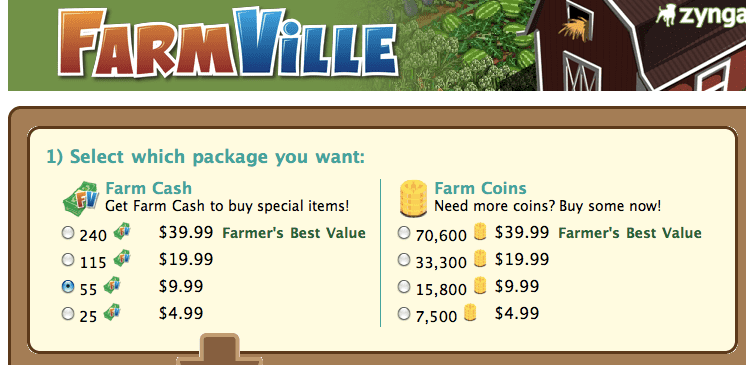
Game seems pretty fun.  But she runs out of seeds, and wants more.  So she goes shopping for virtual goods.
Screen shot 2009-09-28 at 1.39.17 PM

Let’s say our protagonist is too young to have a credit card, so she decides instead to buy coins by signing up for a free offer.

Screen shot 2009-09-28 at 1.39.25 PM

She decides to download a toolbar.  Free greeting cards seem like fun.

Screen shot 2009-09-28 at 1.39.56 PM

The download puts an Ask.com search toolbar in the user’s browser.  Ask.com makes money off search ads.  Ask probably paid $1 to $2 for the install.  Some portion of that goes to Zynga, and then back to Facebook when Zynga advertises.

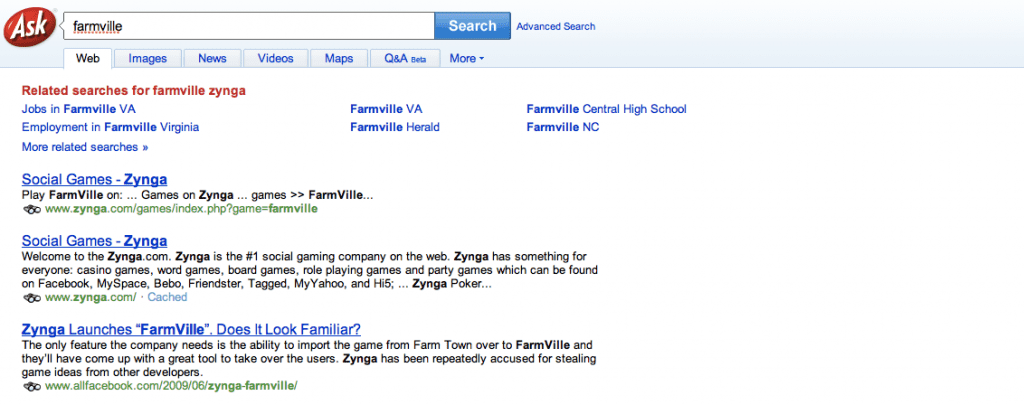
Farmville apparently does not advertise on Ask.com:
Screen shot 2009-09-28 at 2.03.02 PM

Thereby preventing the entire new internet economy from imploding in an endless cycle of circularity.

  • http://LeanStartups.com Apolinaras Sinkevicius

    So how sustainable do you this this business model is?

    • http://www.cdixon.org chris dixon

      I guess it's sustainable as long as real cash enters the system (user buys goods with credit cards, user buys goods with credit card after clicking on Ask.com adds etc).

      • http://LeanStartups.com Apolinaras Sinkevicius

        What I wonder is how long until the target audience grows up and realizes you can get better entertainment for your $. Or the marketplace gets so overcrowded, that it becomes like iPhone applications.
        The attention span and loyalty of target groups is fickle.

        • sidviswanathan

          I would imagine that as those who grow too old for virtual goods phase out, the new younger generation will step right in to take their place and if I'm not mistaken that's the segment growing the fastest within the Facebook community. Wonder if anyone will distribute real merchandise through Facebook channels using credits system

          • http://LeanStartups.com Apolinaras Sinkevicius

            Trouble is, gen Ys and younger are ABANDONING Facebook. Growing demo on social networks are boomers not tweens.

          • triploculturado

            agree. I play with my kids and they seemed immune to the whole online ad schema just yet… they focus on the actual game playing and as long as it is fun, they will.

      • http://www.twitter.com/aainslie Alexander Ainslie (@AAinslie)

        Chris, this is a similar revenue engine that supports the entire online & offline poker industry. A sustainable poker platform needs “Fish” (loosing or weak players) for the ecosystem to feed on. When the supply of fish decrease the predatory players move on to the next table or site.

        I think it is fortunate that Zygna has Farmville and other revenue engines in its portfolio as my informed opinion is that the probability is very high that the DoJ (US Dept. of Justice) will come down on Zygna's poker offering.

        I believe this looming legal and regulatory risk is the reason that Max Levchin and his Slide organisation and other well funded social gaming companies haven't gone after this juicy, fairly low hanging, opportunity to generate revenues at scale in very short time frame.
        http://www.twitter.com/aainslie

    • http://dreamdebris.com/ Anees Uddin

      Seems like a quick buck economy at the moment, however i think there's room for more mature applications that don't offer spammish arbritary deals.

  • http://twitter.com/vsagarv Vijaya Sagar

    Hilarious stuff. Especially the finishing note on endless recursion of ads :) Glad that someone within the “online” industry is taking potshots at this mindless way of generating ad-revenues (which is a mindnumbingly dumb model). Almost every site that we go to these days, is molested so to say, by some totally irrelevent ad or the other.

    I vaguely remember someone from Basecamp (DHH?) talking about the lost art of making compelling enough products at an affordable price, that people actually want to pay for.

    • http://www.cdixon.org chris dixon

      I didn't really mean to be taking potshots. I was just amused by the virtualness and circularity of the whole thing. I have nothing against games or toolbars etc (assuming they clearly disclose etc).

  • http://thedreaminaction.com/ ryangraves

    Chris-

    Maybe a better title is “A new economy” seems there are many new micro-web-economies poping up with the e-e-commerce.

    Just a thought.

  • http://giffconstable.com giffc

    I can't remember whether it was Zynga or Playfish, but I remember hearing a breakdown of: 1/3 revenue from virtual good/currency sales for cash, 1/3 for ads/integrated sponsors, and 1/3 for virtual good/currency sales for offers (like the toolbar example you mention)… i.e. it doesn't define their business but it makes up a large chunk. I for one don't think offer-based revenue streams are that sustainable in the social games space because advertisers will start questioning the quality of the consumer. Will be interesting to watch.

    On a totally different note, it has been simply amazing to watch Facebook leave huge amounts of virtual goods revenue on the table, and dismiss it as niche for so long in favor of advertising. That attitude seems to be changing, and their Facebook currency should help them tap into that rev stream.

  • http://portal.eqentia.com William Mougayar

    Welcome to the token-economy.
    I wonder what the real stat is for age groups for these users.

  • http://andywibbels.com/ Andymatic

    Our household has caught the Farmville bug and we've never had to buy extra seeds. Maybe they count on people how are bit more impatient than I.

    • http://www.cdixon.org chris dixon

      They supposedly have 50M active users. So if they get a $1/yr on average from each of one (1 toolbar) that's a big business.

      Maybe I should play Farmville more – it's really fun? I'm usually more of an Xbox type.

      • http://andywibbels.com/ Andymatic

        I don't know if I'd say 'fun' but they do a good job of sucking you in. They always give you something new to do – like when you are waiting for your crops to mature you can go rake leaves or chase crows on the farms of your friends. Yeah, it's sick. :)

      • http://davidcancel.com/ David Cancel

        To achieve full nirvana state Facebook needs to also provide the monetization options used within the apps. Then its a closed-loop and ensures new money keeps coming into the system.

        I.E:

        Google Adwords+SEO Secrets+Google Adsense == Nirvana

      • http://bit.ly/19kduZ Greg4

        Personally, I wouldn't recommend it. They've raised grinding to an art form. Think World of Warcraft with carrots.

        Not to say that I didn't have an unfortunate Mafia Wars fling…

  • david ingerman

    You should get Facebook, Zynga and Ask to all advertise on your blog so you too can make a little something off the people who read about how each of the players make a little something off all of the people who click from one of their properties to another…

    • http://www.cdixon.org chris dixon

      That would be super-meta!

  • http://twitter.com/michaeljung michaeljung

    Virtual goods is so … mhh … an Asia thing. It never caught on in the west or europe as everybody (start-ups & investors) hoped. It has smth to do with the culture there. As with the target group.

    But nice to know u misused IE for that analysis.

    • http://www.cdixon.org chris dixon

      They say Zynga is making >$100M in revenues, so I think it has caught on in the US.

      Dude, I use Safari & FF only :) That's a screenshot from the myfuncards website.

  • http://www.willanjohnson.com Willan

    I believe the offers (Discover Card, Toolbar, etc) are served up by OfferPal (venture backed startup). So your model still holds, just that Zygna is getting a cut of the revenue from ASK…not whole $1 or $2).

  • http://twitter.com/pc4media pc4media

    This kind of arbitrage is pretty common, especially among the younger demographics. This has been going on since before myspace. The soc nets have just turned it into an art form. There is a report that Comscore did recently on who the biggest advertisers on the soc nets are. It's pretty interesting.

    Not sure if I can paste a link here. But, here's the link: http://www.comscore.com/Press_Events/Press_Rele

    • http://www.cdixon.org chris dixon

      Interesting. What's experian running? Free credit report stuff?

  • http://www.charleshudson.net chudson

    Chris,

    If you're interested in virtual goods (or have friends) who are, I'd encourage you to check out the Virtual Goods Summit (http://vgsummit2009.eventbrite.com) – we've been covering this space for 3 years and have a lot of the leading companies in the US and Asia presenting in late October.

  • Pingback: Howard Lindzon » Blog Archive » Deep ‘New Economy’ Thoughts – AssSphincterSaysWhat?

  • http://kirigin.com Ivan Kirigin

    Not all people paying are taking offers. Huge gaming platforms like X Box have thriving virtual goods businesses based on storing and processing credit cards. Those paying aren't necessarily young.

    Most people who own rockband or guitar hero are going through the same process. It is not a fault of Zynga that advertising can be effectively utilized to bring people in game. It's a benefit. Harmonix would love it if you could see an ad on facebook, and be a few clicks away from giving them money while playing their game.

    That said, I think offers are quite ugly. They offer a poor user experience. I'd prefer people just become banked at a younger age, or use some sort of game card system.

    • http://www.cdixon.org chris dixon

      Yep, I've paid for guitar hero songs.

  • Pingback: Drawing Circles Around the New Economy | AaronKlein.com

  • gavinbaker

    Wow – hadn't put it together quite like that. Well done! Reminds me of the TC post about companies paying facebook to drive traffic to…. a different part of facebook. http://www.techcrunch.com/2009/09/01/brilliant-

    At the end of the day, I personally can't imagine paying real money for virtual goods, but I'm apparently in the minority! Only wish my brain worked in a way that it made sense to me.

  • http://twitter.com/fromedome Dan Frommer

    This is an awesome post. That's all.

  • http://burgherjon.blogspot.com/ Burgher Jon

    It's become more of a niche, but one shouldn't forget about Second Life in this conversation. Especially with enough money floating around in the second life for some woman in Germany to make $1M US “in game”. http://en.wikipedia.org/wiki/Anshe_Chung

  • michaeljordanshoes
  • Pingback: Weekend Reading

  • Pingback: Social Games: How The Big Three Make Millions | Stoth

  • Pingback: Tech News World » Social Games: How The Big Three Make Millions

  • Pingback: Social Games: How The Big Three Make Millions |

  • Pingback: Social Games: How The Big Three Make Millions | Dipnip

  • Pingback: Social Games: How The Big Three Make Millions | Tech stuff center

  • Pingback: Missed SAW VI, I was playing Farmville | Film Futurist

  • http://makeitrank.com/ Kevin Spence

    This model is hella sustainable, and it's how I see the web moving. Basic features for free, premium features cost $$$

  • Pingback: Avatar « Dan

  • Pingback: Social games – gry ze społecznością | AK74 - blog Artura Kurasińskiego (cc) 2007

  • Pingback: Technology blog » Social Games: How The Big Three Make Millions

  • http://www.victusspiritus.com/ Mark Essel

    There's certainly value in entertainment. If buying virtual goods equates to virtual empowerment I can see the mixed feelings on selling a charlatans miracle elixir.

    But if the experiences a person has are real in a virtual environment or game, isn't that the definition of personal value.

    I'd like to see the sheister promotions cleaned up, and transparent revenue streams evolve in social games.

    Fourth popular post, 7/10 Chris. It's a big deal looking at the new economy but I think this topic is better served by thr depth and care of Kevin Kelly's new economy. If you haven't read it, I highly recommend it. I'm only a couple dozen pages in but I'm a regular reader of Kevin's work. He probes deeper into the shift of value in our exports globally and what that could mean for our future commerce and business structures.

  • http://www.victusspiritus.com/ Mark Essel

    There's certainly value in entertainment. If buying virtual goods equates to virtual empowerment I can see the mixed feelings on selling a charlatans miracle elixir.

    But if the experiences a person has are real in a virtual environment or game, isn't that the definition of personal value.

    I'd like to see the sheister promotions cleaned up, and transparent revenue streams evolve in social games.

    Fourth popular post, 7/10 Chris. It's a big deal looking at the new economy but I think this topic is better served by thr depth and care of Kevin Kelly's new economy. If you haven't read it, I highly recommend it. I'm only a couple dozen pages in but I'm a regular reader of Kevin's work. He probes deeper into the shift of value in our exports globally and what that could mean for our future commerce and business structures.

  • Pingback: SlideShare gets into the lead gen, PPC business » Troy Cornejo

  • Pingback: Welcome to ElChino-ville! A Place of Villany And Scum… « The Office of El Chino