Dow 10,000 and economic reflexivity

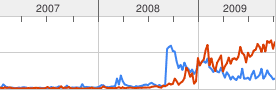
People who criticize Obama’s economic policies forget that, around the beginning of this year, a lot of serious people thought we were entering a second Great Depression.  Here are the Google News mentions of the words “Great Depression” (in blue) and “economic recovery” (in red) over the last three years:
Screen shot 2009-10-17 at 4.16.11 PM

Moreover, most experts thought we were being led into a Great Depression not by “fundamentals” but by the collapse of the financial system.

Back around when Obama proposed his bank bailout plan (which was mostly an extension of Bush and Bernanke’s plan) he was widely criticized.  The consensus criticism was succinctly summarized by Nobel Laureate Joseph Steiglitz:

Paying fair market values for the assets will not work. Only by overpaying for the assets will the banks be adequately recapitalized. But overpaying for the assets simply shifts the losses to the government. In other words, the Geithner plan works only if and when the taxpayer loses big time.

Around this time, I happened to bump into an old friend who was working at a hedge fund where his full-time job was trading these so-called toxic assets (CDSs, CDOs, etc).  I asked him the trillion dollar question:  what did he think the “fair market value” for these assets was? Were they worth, say, 80 cents on the dollar as the banks were claiming, or 20 cents on the dollar as the bidders in the market were offering.

His answer:  These assets are essentially bets on home mortgages, which in turn are dependent on housing prices, which in turn are dependent on the economy, which in turn is highly dependent on whether the banks stay solvent, which is dependent on what these assets are worth.

This circularity is not unique to these particular assets.  As George Soros has argued for decades, all economic systems are profoundly circular, a property that he calls reflexivity.

The bank bailouts were extremely distasteful in many ways.  Lots of underserving people got rich.  Institutions that should have failed didn’t.  Dangerous “moral hazard” precedents were set. But the fact remains:  by altering perceptions, the Bush/Obama/Bernanke plan seems to have turned the second Great Depression into “merely” a bad recession.

The Dow passed the symbolic milestone of 10,000 recently.  People who say it’s an illusion and doesn’t reflect economic fundamentals don’t understand that in economics, perception and fundamentals are inextricably linked.

Share:
  • Digg
  • del.icio.us
  • Facebook
  • Google Bookmarks
  • Reddit
  • Slashdot
  • Suggest to Techmeme via Twitter
  • Tumblr
  • Twitter
  • HackerNews

Related posts:

  1. From 1999

View Comments

#1 ewiesen on 10.17.09 at 2:11 pm

Chris – I agree with you entirely that economics is essentially horizontally-summed psychology, and that the perception tail does wag the economy dog.

But I disagree with the implication (and it's just an implication in your post) that we are out of the woods because public perception and media coverage is predominantly oriented toward recovery. The risk of “Great Depression II” is significantly alleviated, but there are big risks still out there (in my view).

To your hedge fund friend's point: mortgages, housing prices, the “real economy” and bank balance sheets – I am deeply bearish on all of these, and it's a dangerous, fascinating experiment to see how long the fed/treasury/media complex can convince consumers that all is well and that they should go out and buy a house they can't afford because there is $8,000 of free taxpayer money in it. Long enough to generate an actual recovery? In my own economic self-interest, I sincerely hope so, but I must confess I am deeply skeptical.

#2 Ben Atlas on 10.17.09 at 2:13 pm

If you really believe in that reflexivity theory you would have do admit that the crash was an aberration. If its true on the downside it could also be true on the upside.

#3 adrianbye on 10.17.09 at 2:18 pm

beautiful use of google trends to make your point

#4 chris dixon on 10.17.09 at 2:22 pm

I don't think we are out of the woods yet. But I do think 10 months ago or so we felt like were were headed for a self-fulfulling Great Depression. E.g. VCs like you had almost completely pulled back.

#5 chris dixon on 10.17.09 at 2:23 pm

If by “aberration” you mean caused primarily by investor psychology, then yes.

#6 chris dixon on 10.17.09 at 2:23 pm

Thanks! I rarely use Google Trends to prove points but it seemed appropriate here.

#7 ewiesen on 10.17.09 at 2:30 pm

We probably agree more than we disagree. Things clearly aren't as bad as they looked in September through March. But I think the pendulum is swinging the other way, and the equities markets and media coverage convince people that this was “just a recession” and that it's over. Between the artificially propped-up housing market, the damaged dollar and unemployment, I think that's very premature.

#8 Jeff Pester on 10.17.09 at 3:42 pm

Nice post Chris – behavioral finance is a fascinating field of study. I'm a big fan of the reflexive theory that George has developed and it's served me well in my investment analysis and decision making. As to Ben's comment; my interpretation of reflexivity is that market moves (both periods of extended under and over valuation) are not aberrations within the confines of the theory – in fact quite the opposite. The theory helps to expose the reasons for the creation and extension of these “aberrant” moves. Maybe I've misread Ben here.

But back to your main point: I'm quite sure that the Obama administration and the Dems are going to be evaluated (and critiqued) on absolute rather than relative economic performance in the next election cycle, and that's unfortunate. The bailout (however flawed) most probably prevented a catostrophic collapse, but of course we'll never know for sure.

#9 chris dixon on 10.17.09 at 3:49 pm

Thanks, Jeff. Re: Dems in next election(s). I think you are right,
and as Democrat myself it worries me.

#10 jdrive on 10.17.09 at 4:16 pm

Perception drives just about everything, despite constant reminders as to just how often it diverges from reality. At a 10k Dow, the campaign to buoy confidence has largely succeeded, and perhaps thankfully so. Still, I can't help but wonder about the consequences at least temporarily masked by all the hoopla, like non-existent credit despite gobs of free money for the banks, heightened class warfare, and the biggest elephant in the room, 10% unemployment….

#11 Dave on 10.17.09 at 11:50 pm

People who say it’s an illusion and doesn’t reflect economic fundamentals don’t understand that in economics, perception and fundamentals are inextricably linked.

This statement indicates that you probably don't actually understand the “fundamentals” underlying modern Western industrial economies.

Public perception has a lot of influence on stock market prices (Is anyone really debating this point?). Public perception has little to do with global oil supply and demand.

#12 tonyleone on 10.18.09 at 1:45 am

Well why bust your heads analyzing this idea if the premise is built on perception which all of the stuff has the propensity to recycle into crap assets as a course of business anyway then what the hedge fund guy above and Soros are saying is what we should know already that Spet 15th 2008 was engineered just as these same people are advocating today to not let that event imprint your neural pathways into believing it today.

The power people in all their convoluted explanations know this to be the case so don't rely on such b/s coming out of their mouths and just follow the indicators when they intend to get up off their big asses and drive an over extended market one way or another just for shits and giggles.

#13 dskills on 10.18.09 at 2:59 am

You miss a key point to the bailout – allowing the banks to ignore mark-to-market accounting. By doing this, the banks were essentially allowed to hold junky assets without having to put up more collateral for them as they decline. By doing this (one could argue it was good or bad), the banks can remain under capitalized for potentially forever (or until the assets come back, if ever, in value).

Dow 10,000 could also be driven by the momentum effect, which has been well documented in economic theory, although no one has yet proposed a reason for why momentum exists.

#14 bthoskins on 10.18.09 at 5:06 am

Chris, agree that we seem to have avoided the latest threat to our economy, but how much has really changed? How much longer can we run massive government deficits, prime the faithful consumer to spend themselves into crazy amounts of debt, and ignore our broken entitlement programs? Structurally, we have serious problems that no one seems willing to face: $58+ trillion of unfunded liabilities from social security and medicare that will come due in the next 10-15 years, a $2 trillion deficit, and $12 trillion in debt for an economy that is $14 trillion? You can't tax or grow your way out of those numbers. Inflating our way out of it is also not an option because our primary liabilities are promises of future services and inflation-adjusted retirement payments. I'm glad the economy seems to be healing, but now we need to turn our attention to how we solve these problems and restructure for long-term sustainable growth.

#15 chris dixon on 10.18.09 at 6:31 am

Of course global oil demand/supply is affected by perception. Oil prices are clearly driven by perception – take a look at an graph of oil prices over the last few years. Oil demand is driven by global economic activity, which is very much driven by investment etc. Oil “supply” isn't about how much oil is in the earth, its about how much oil can be profitably retrieved at current oil prices.

#16 chris dixon on 10.18.09 at 6:31 am

Yes, agree that is important. I was actually a proponent of mark-to-market.

#17 Mike Dolan on 10.18.09 at 9:53 am

Dow at 10,000 has the purchasing power of a DOW of 7500 10 years ago. Also the dow of 10,000 is not the same as the dow 0f 10,000 a few weeks ago if it had even reached it. The $ is falling like a rock.

#18 gregory on 10.18.09 at 5:28 pm

This is all well and good, but what do you make of the fact that while the likelihood of a great depression occurring has fluctuated over the past six years, the likelihood of a teleport machine being invented has steadily dropped http://bit.ly/4bKr3q

#19 chris dixon on 10.18.09 at 5:30 pm

:) That's why I only look at Google News mentions (bottom graph), not query frequency.

#20 Alex Rosenfeld on 10.18.09 at 8:51 pm

My aunt forwarded this to me earlier in the week. It struck me as a nice little allegory for the reflexivity you reference…

***

It's late fall and the Indians on a remote reservation in South Dakota asked their new chief if the coming winter was going to be cold or mild.

Since he was a chief in a modern society, he had never been taught the old secrets. When he looked at the sky, he couldn't tell what the winter was going to be like.

Nevertheless, to be on the safe side, he told his tribe that the winter was indeed going to be cold and that the members of the village should collect firewood to be prepared..

But, being a practical leader, after several days, he got an idea. He went to the phone booth, called the National Weather Service and asked, 'Is the coming winter going to be cold?'

'It looks like this winter is going to be quite cold,' the meteorologist at the weather service responded.

So the chief went back to his people and told them to collect even more firewood in order to be prepared.

A week later, he called the National Weather Service again. 'Does it still look like it is going to be a very cold winter?'

'Yes,' the man at National Weather Service again replied, 'it's going to be a very cold winter.'

The chief again went back to his people and ordered them to collect every scrap of firewood they could find.

Two weeks later, the chief called the National Weather Service again. 'Are you absolutely sure that the winter is going to be very cold?'

'Absolutely,' the man replied. 'It's looking more and more like it is going to be one of the coldest winters we've ever seen.'

'How can you be so sure?' the chief asked.

The weatherman replied, 'The Indians are collecting firewood like crazy.'

#21 mayanks on 10.18.09 at 9:55 pm

Indeed the last year has been a huge roller coster ride for everyone. At the onset it did look like the big depression coming back, but the timely intervention and injection of huge funds by governments around the world seems to have brought things back to normal.

I clearly do not understand economics and have no formal training in that field. I think myself to be a logical person and from what little I have read over the internet it does seem to me that the fundamentals are just not strong yet. The banks have been bailed out, and I don't know how the government will recover it's money But these financial institutions will have to show some growth cause they are not government. And growing in this post recession environment will have to be done by taking risks. So how could we possibly be recovering when these finance institutions are going back to their ways?

To me as Nassim Nicholas Taleb would say, we are being fooled by randomness. I may be totally wrong (I hope so) but logically it just doesn't add up for me.

#22 msuster on 10.19.09 at 1:08 am

Hey Chris. I agree with mostly everything in your post with the exception of the sentiment of the final paragraph.

I agree that the economy and consumer psyche are linked and can have an impact on the “real economy” but there are certain fundamentals that can override things. For example, unemployment continues to go up. If this continues the market will adjust and it could be swiftly. Many smart thinkers believe this will happen.

I believe that the current market levels are supported by a rise in consumer sentiment that has fueled consumer spending. But this consumer spending is fundamentally unsustainable. Why? First, that pesky unemployment has a correlation with housing prices. We spend when we feel the “wealth effect” and when we think we have equity in our homes and bank. Second, there is an inverse correlation between unemployment and housing prices. Third, despite increases in savings lately we are still in too much consumer debt as a nation. Fourth, banks are tightening what credit is available for consumers. Fifth, less jobs, heavy consumer debt, less credit, lower housing prices means … less spending. And thus the stock market pulls back leading to … lower retirement money and therefore less “wealth effect.” I'm just sayin' – sentiment is important, just not everything.

But as for the necessity of the bank bailout – I'm with ya.

#23 chris dixon on 10.19.09 at 5:33 am

Mark – I by no means think we are out of the woods, and agree unemployment looms large. That said, the good scenario is Dow 10,000 means consumers feel better, which leads to earning (see Google etc recently) which leads to hiring etc. In that sense perception can affect reality. But its also not everything.

Main main point here was to counter what a lot of criticisms I hear about the Bush/Obama bailout. I think people are forgetting how dire things were 10 months ago.

#24 msuster on 10.19.09 at 8:08 am

Hey Chris. I agree with mostly everything in your post with the exception of the sentiment of the final paragraph.

I agree that the economy and consumer psyche are linked and can have an impact on the “real economy” but there are certain fundamentals that can override things. For example, unemployment continues to go up. If this continues the market will adjust and it could be swiftly. Many smart thinkers believe this will happen.

I believe that the current market levels are supported by a rise in consumer sentiment that has fueled consumer spending. But this consumer spending is fundamentally unsustainable. Why? First, that pesky unemployment has a correlation with housing prices. We spend when we feel the “wealth effect” and when we think we have equity in our homes and bank. Second, there is an inverse correlation between unemployment and housing prices. Third, despite increases in savings lately we are still in too much consumer debt as a nation. Fourth, banks are tightening what credit is available for consumers. Fifth, less jobs, heavy consumer debt, less credit, lower housing prices means … less spending. And thus the stock market pulls back leading to … lower retirement money and therefore less “wealth effect.” I'm just sayin' – sentiment is important, just not everything.

But as for the necessity of the bank bailout – I'm with ya.

#25 Dow 10,000 and economic reflexivity | Igniting Startups - nPost on 10.19.09 at 10:39 am

[...] From cdixon.org [...]

#26 chris dixon on 10.19.09 at 12:33 pm

Mark – I by no means think we are out of the woods, and agree unemployment looms large. That said, the good scenario is Dow 10,000 means consumers feel better, which leads to earning (see Google etc recently) which leads to hiring etc. In that sense perception can affect reality. But its also not everything.

Main main point here was to counter what a lot of criticisms I hear about the Bush/Obama bailout. I think people are forgetting how dire things were 10 months ago.

blog comments powered by Disqus