Google’s feature creep

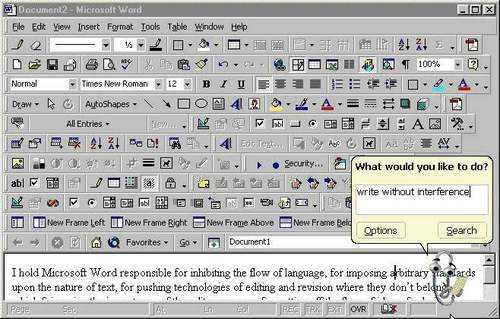
Microsoft used to be considered the king of feature creep.  Here was Microsoft Word when it was most cluttered:

thumb-paperclipinterference

I don’t use any of Microsoft’s software anymore, but from what I hear they’ve toned down the feature creep a lot in recent versions of Windows and Word.

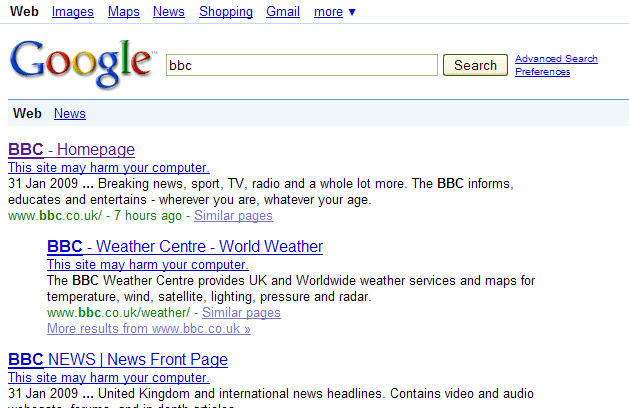
Google has been adding so many new features to its results page, they are starting to feel like the new Microsoft.  Here’s an approximation of what Google used to look like (I couldn’t find an image of actual Google 1998 SRPs — anyone have one?)

bbc-google-search

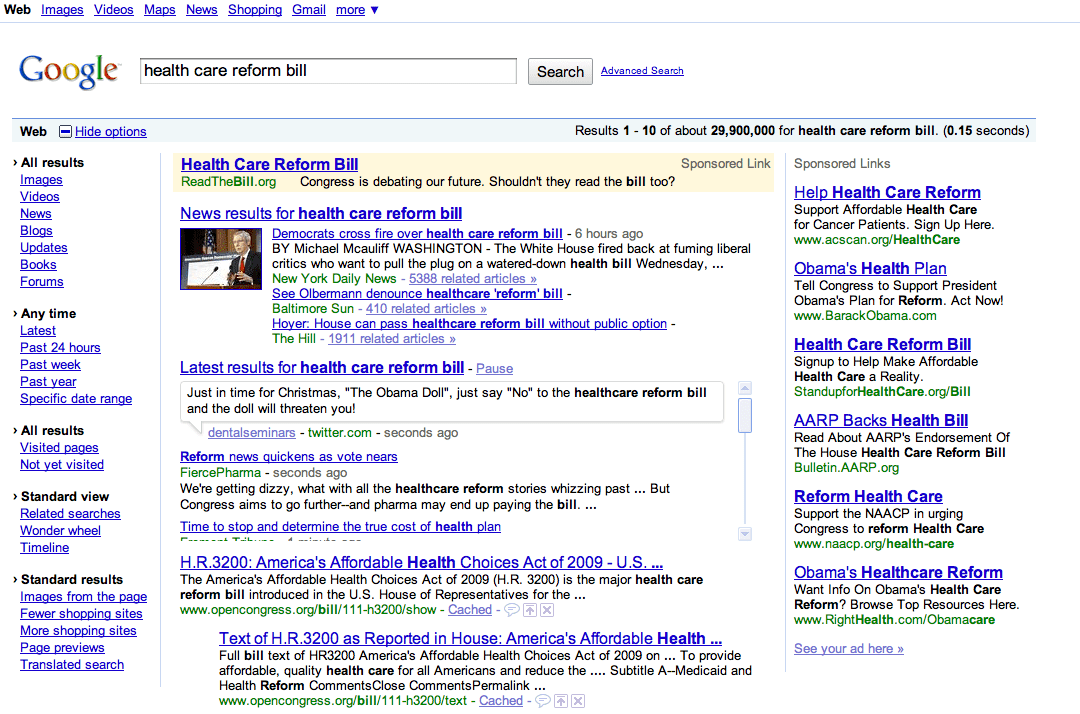
And here is Google today:

Screen shot 2009-12-17 at 11.35.35 AM

Options on the left, ads on top and on the right, news results up top, images, and buttons to vote results up/down and annotate them.  But worst of all are the new scrolling “real time” results.  The static image I’ve embedded doesn’t do justice to how annoying this is. Random, out-of-context, and mostly asinine fragments of conversations scrolling by.  I think it might be Google’s Clippy.

Share:
  • Digg
  • del.icio.us
  • Facebook
  • Google Bookmarks
  • Reddit
  • Slashdot
  • Suggest to Techmeme via Twitter
  • Tumblr
  • Twitter
  • HackerNews

Related posts:

  1. What’s strategic for Google?
  2. Google should open source what actually matters: their search ranking algorithm
  3. Remember when everyone wondered how Google was going to make money?

View Comments

#1 Michael Bolin on 12.17.09 at 10:44 am

If you think the future of search is in matching URLs with keywords (as it was in 1998), then you are sadly mistaken. The focus needs to be on trying to identify the goal the user is trying to achieve and then presenting the user with a tool to accomplish that goal. As a simple, when the goal is to watch the wedding dance YouTube video, show the user the video rather than providing a link to the video. For sure, Google must be careful about how it introduces new features, but returning to 1998 is not the solution.

#2 chris dixon on 12.17.09 at 10:48 am

I agree. I just don't think what the are doing now – throwing tons of stuff at the user – is making progress.

#3 jeremy on 12.17.09 at 11:18 am

The options on the left are useful features. The ads on the top and on the right are not quite as necessary. I know which clutter I would get rid of, first, if given the choice.

I'd invite you to take a second look at this screenshot, and count the number of results:

(1) By pure link count, there are three news results, two real time results, and two web page results. Total = 7.

(2) By diversity count, there are only three results, total: A news chunk, a real time chunk, and one (only one!) web site (with a subresult from that same site). Total = 3.

Now, let's count the number of advertisements on the page: one up top and six on the side. Total = 7.

Under one interpretation of the number of Google SERP results, there are over twice as many ads (7) as there are organic results (3). Under a more generous interpretation of SERP counts, there are an equal number of results and ads (7).

Either way, I have a very, very difficult time believing that ads are just as relevant as organic results, to the point where Google believes it has to show at least as many ads as organic results, if not more.

I'm not concerned about feature creep. I am instead concerned about ad creep. Get rid of so many ads, and then put the scrolling real time updates somewhere on the page where the ads used to be, and I would be happy. And that also leaves more room for more than just 1 or 2 web page results, too!

#4 chris dixon on 12.17.09 at 11:21 am

Fair point. In the back of my mind I've always wondered if Google's business is built on the fact that most web users don't know which are sponsored and which are organic (70% don't know the difference or something like that). Google claims the ads can be more relevant, which I've found in some cases but certainly not in general.

To Google's credit, they do limit the ads on lots of keywords (using minimum eCPM's/quality score), unlike other search engines that show tons of ads on any query at all.

#5 kevotheclone on 12.17.09 at 11:22 am

This is the oldest picture of Google's search interface (not the search results) I could find. :-)
http://deems.files.wordpress.com/2009/04/google...

BTW Chris, nice work on Hunch!

#6 jeremy on 12.17.09 at 11:46 am

Yes, I also do not hesitate to give Google credit for limiting the ads on a lot of keywords. But those keywords for which they don't show ads are also keywords that probably don't need real-time scrolling results, y'know?

You said it yourself the other day: Google makes its money on (shows the most ads for) for flights, dvds, lawyers, etc. However, these are also topics where there is a whole lot more organic information, too. They are topics for which more “creeping” features almost become a necessity to help people organize that information. Yet these are exactly the topics for which more ads are shown, rather than more relevant search features!

These domains are screaming out for more helpful features to help us sort through all the available information. But all we get instead are ads.

Clippy is not the problem. Lack of screen real estate to be able to develop something better than clippy is the problem. And that lack of real estate arises because so many ads are shown.

#7 umairmufti on 12.17.09 at 2:32 pm

i have a google screenshot circa 2000 on my blog post here: http://flint.sparcq.com/2009/10/the-year-2000-p...

the additional search features and results don't bother me so much. to me, the issue is with presentment. of course, any interface design must balance functionality with ease of use. striking a balance is often very difficult.

ironically, the blog post i reference above makes the case that google's early success depended largely on its minimal interface. i wonder if there will be a lite.google.com coming soon…

#8 rikin on 12.17.09 at 4:43 pm

I think calling it Clippy is about the harshest criticism you could give. Unfortunately, I agree it's pretty fitting though most likely not as bad as Word with every toolbar enabled.

What scares me though is that most of the clutter isn't even useful to the user. Most of those features are there for advertising or because of business development deals with the likes of Twitter. Search for a music artist and you'll be met with Rhapsody and iLike.

I can see what Google is trying to do but by aligning with certain companies you will not only piss of a few others but you'll limit other partnership opportunities.. (Ty Ahmed-Taylor says something similar about Vevo).

On a slightly different note, I think the end of 2009 marks the beginning of a tangible Google backlash.

#9 chris dixon on 12.17.09 at 5:25 pm

3 x agree

#10 chris dixon on 12.17.09 at 5:26 pm

i for one would love a lite.google.com

#11 AndreaF on 12.18.09 at 12:57 am

I have found that in the last 12 months or so Google results have become less relevant and more cluttered. I have switched to Bing and never looked back. I only use Google for news and occasionally I double check some of the Bing results but I have never found more relevant stuff on Google.
I believe that the problem is that, in the past, Google was trying to remove clutter and features from their site and make it as simple as possible, a la Apple. Now, they are just adding ads and features making a big mistake. I feel they ran out of innovative ideas on Search for now and they are just trying to squeeze every dollar they can from it before the game changes. Their sponsored results are misleading and I avoid them (maybe wrongly) out of principle.

#12 Mark Essel on 12.18.09 at 2:51 am

Great advice to Googlers Jeremy. They will surely be measuring feedback and optimizing though.

Only 2 sites (1 sub page).. Well all I can say is that we may need the folder on the side, but in a mouse over slide out way (too fancy?)

I like preserving active screen real estate by hiding and sliding out “secret lair” styles.

#13 alex on 12.18.09 at 3:36 am

I realize the focus of this post is on feature creep, but what about content creep? Google's gradually, in some cases sneakily, transformed itself from being a launching point for the internet to a aggregator of content. In the process, they're dumbing down content and suffocating content creators of all kinds. I think, especially in light of Google's potential acquisition of Yelp, a lot of “new media” guys are going to wake up and realize that this is an issue as relevant to them as it is to the Rupert Murdochs of the world. Google might claim it's a symbiotic model, but it's symbiotic up to the point that content creators are left without a business model, and then the whole ecosystem breaks down. The last 10 years has seen a tremendous flowering of online content, diverse and passionate and intelligent voices emanating from user-generated to real-time to blogs platforms, and even from old media, who have in many cases made successful transitions to the web, c.f. the New York Times. 2010 marking the beginning of a great backlash against Google? If that's what it takes to preserve this renaissance and the benefits it's bestowed on society, let's see it.

#14 chris dixon on 12.18.09 at 5:20 am

I haven't spent enough time with Bing as a user but I can tell you from the website owner side they are incredibly slow to index content versus Google.

#15 chris dixon on 12.18.09 at 5:22 am

Very true and very good point. If they do buy Yelp, they'll be buying one of the major beneficiaries of google organic results. I'm trying to think of other acquisitions they did where this was the case. It might mark a turning point indeed.

#16 AndreaF on 12.18.09 at 6:47 am

You're right. They are inexplicably and very annoyingly slow at indexing new sites.
I guess Google's strengths are its indexing and searching capabilities. Bing is stronger at presenting the results.

#17 alex on 12.18.09 at 10:28 am

I think it extends beyond outright acquisitions to partnerships and even their day-to-day centralization of external content across their various (and, to your point, cluttered) features and portals. Google, which once played the champion of niche content on the web by efficiently connecting audiences with content creators, is slowly emerging as the death-knell of those creators – including vibrant user-creator communities, in the cast of user-generated content.

A good and recent example of this is the music partnerships with iLike, Imeem, Lala, etc.. It's difficult to tell whether these deals were economically sensible for these businesses, but from a competitive standpoint, these guys had no other choice, i.e. if one decided not to accept the deal, their competitors certainly would. This attests to the monopolistic power Google is beginning to wield. Of course, Google will argue that they're helping these guys create a viable business model, but the reality is they're rendering these businesses irrelevant. Do you think most users will really care who's delivering their streams as long as they can access them within seconds on Google's music interface?

Despite the big step backward the record industry has taken over the past ten years, the ways that users consume, interact with, share, and appreciate music has been revolutionized by many of the players whose offerings are now being “dumbed down” by Google. Say what you want about the power that Apple wields in digital music, but I was enthusiastic to see them acquire Lala, because I trust Steve Jobs to continue to accelerate digital music's evolution in a manner that enhances the user experience, benefits the art form, and creates a sustainable business model. Eric Schmidt & Co.? Not so much.

Sorry for being long-winded. I'm sure we could brainstorm a handful of other examples. But one thing's for sure…the “don't be evil days” are long passed. Even if it's inadvertant, Google's current strategy poses some frightening implications for content on the web that I think people are slowly waking up to.

#18 Nate Graves on 12.18.09 at 10:30 am

So, I’ve had a couple of thoughts related to this. It does seem pretty clear that Google is experiencing some kind of creep amidst their search results. One thought I’ve had is that maybe Google is introducing these new elements as a means of forcing users to do less scanning. Google makes money if people click on ads. The less the Google page changes, the easier it becomes for users to scan through information. The more users scan, the less they pay attention to ads. So, possibly Google is trying to break up the typical visual pattern as a means of driving users back to clicking on ads.

The other thought that I recently had was that as Google includes more data sources (e.g. music results from Lala, profile info from FB, tweets from Twitter, game ratings from GameSpot, potentially restaurant reviews from Yelp, etc.) will it end up reducing traffic to destination sites? I mean it seems like destination sites would just be content producers with the content included in snippets in Google’s search results.

#19 Tom Piamenta on 12.19.09 at 2:17 am

I always felt that hiring someone to manage your investment portfolio was dumb. In order to justify their commission and existence they have to do s-o-m-e-t-h-i-n-g. They buy, sell, hedge or whatever instead of just clinging to a good portfolio and letting it grow. The result is far less than optimal.
Same for Google.. even if you have an amazing simple product, what will you do with the $#I^loads of designers, programmers and consultants?… How can you just let the product rest?
lite.google.com is a fabulous idea…

#20 Ben Kessler on 12.19.09 at 10:22 am

How about the new experimental design with COLOR?

http://twitpic.com/u1xuf/full

#21 dave kellogg on 12.21.09 at 1:08 pm

Totally agree on the scrolling real-time results — annoying!

#22 Google’s feature creep | Igniting Startups - nPost on 12.21.09 at 1:49 pm

[...] From cdixon.org [...]

#23 aseidman on 12.22.09 at 1:49 pm

YouTube is a content play they acquired that benefited from both social networks and search engines.

At a macro level they realize that they need to own certain high value content sources (maps, local). Why? If one player dominates (e.g. Amazon in shopping or iTunes in music) a large and lucrative vertical category they could pull a large set of query traffic away from Google.

#24 wilner on 12.26.09 at 11:15 pm

People have been talking about a Google backlash since before 2004, and nearly each year since then. But no tangible backlash has ever materialized. But given that it took Microsoft decades to develop a similar backlash against it, perhaps it's just a matter of time. I personally have been trying to wean myself off of Google. So far I've stopped using Google search and maps, but I still use Youtube and Translate services, and my work forces me to use Gmail (which I couldn't stand from the start.)

#25 wilner on 12.26.09 at 11:16 pm

You're right about that. I've tried Bing and it's good but their indexing is very slow. Why is it so slow?

#26 rikin on 12.28.09 at 8:42 pm

@wilner, agreed talks of it have been around for a while but everyday comes another anti-Google post and I can't help but think that 2010 might just be the year some one does something about it. Even if it's a company putting in a no-robots.txt line.

#27 traxor on 12.30.09 at 10:11 am

Luckily though, Google is free. Part of the complaint of Microsoft's software is that you're paying for cluttered software when it needn't be so.

Shame.

#28 traxor on 12.30.09 at 6:11 pm

Luckily though, Google is free. Part of the complaint of Microsoft's software is that you're paying for cluttered software when it needn't be so.

Shame.

blog comments powered by Disqus