Chris Dixon

While Google fights on the edges, Amazon is attacking their core

Google is fighting battles on almost every front:  social networking, mobile operating systems, web browsers, office apps, and so on.  Much of this makes sense, inasmuch as it is strategic for them to dominate or commoditize each layer that stands between human beings and online ads.  But while they are doing this, they are leaving their core business vulnerable, particularly to Amazon.

When legendary VC John Doerr quit Amazon’s board a few months ago, savvy industry observers like TechCrunch speculated that Google might begin directly competing with Amazon:

[Google] competes with Amazon in a number of areas, particularly web services and big data. And down the road, Google may compete directly in other ways as well. Froogle was a flop, but don’t think Google doesn’t want a bigger chunk of ecommerce revenue from people who begin their product searches on their search engine.*

In fact, Google and Amazon’s are already direct competitors in their core businesses. Like Amazon, Google makes the vast majority of its revenue from users who are looking to make an online purchase. Other query types – searches related to news, blog posts, funny videos, etc. – are mostly a loss leaders for Google.

The key risk for Google is that they are heavily dependent on online purchasing being a two-stage process:  the user does a search on Google, and then clicks on an ad to buy something on another site. As long as the e-commerce world is sufficiently fragmented, users will prefer an intermediary like Google to help them find the right product or merchant. But as Amazon increasingly dominates the e-commerce market, this fragmentation could go away along with users’ need for an intermediary.**
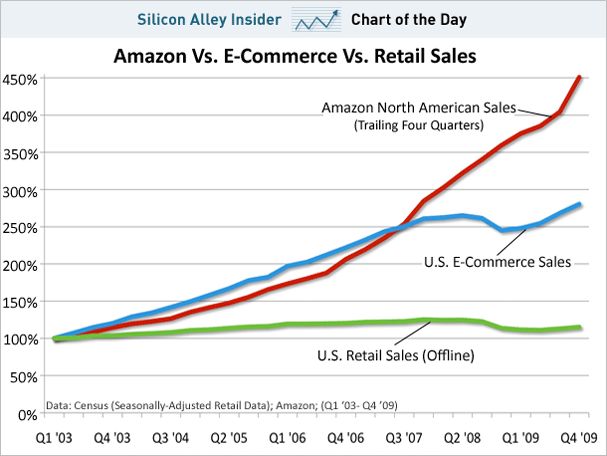
Moreover, Google’s algorithmic results for product searches are generally poor. (Try using Google to decide what dishwasher to buy). These poor results might actually lead to short term revenue increases since the sponsored links are superior to the unsponsored ones.  But long term if Google continues producing poor product search results and Amazon continues consolidating the e-commerce market, Google’s core business is at serious risk.

* Froogle (and Google Products) have been unsuccessful most likely because Google has had no incentive to make them better: they make plenty of money on these queries already on a CPC basis, and would likely make less if they moved to a CPA model.

** Most Amazon Prime customers probably already do skip Google and go directly to Amazon.  I know I do.

  • Pingback: Sunset Slide

  • Pingback: Mortgage Ontario Canada | Refinance My Mortgage

  • http://blindfiveyearold.com AJ Kohn

    I usually find your analysis to be incredibly right, but this time I disagree.

    Google and Amazon have been in a quiet feud for a long time. You’re right about Google wanting more of the eCommerce market. And you’re right about Froogle flopping.

    But the backbone of Froogle was Google Base – and that still exists, powering Google Product Search, which is being offered more and more through ‘onebox’ presentations.

    http://www.blindfiveyearold.com/image-based-google-shopping-onebox

    The initial idea was to connect Google Checkout with Froogle and cut out all of the intermediaries like … Amazon. While they botched both rollouts, they still exist, along with the nifty Google Dashboard which can track all your purchases.

    But lets not forget about books, which a colleague of mine referred to as the milk of the Internet. It’s at the core of Amazon’s business and Google took aim at it well over 5 years ago as it began to scan books. And Google Base was originally built with books, music and video in mind.

    Shortly after Google announced the Google Books Settlement Agreement, Amazon stopped paying affiliates for keyword bidding traffic. It was a fairly transparent response to shutting out incremental AdWords revenue.

    http://www.azhttp.com/2009/04/06/amazon-associates-program/

    Google’s taken the long-view on their war with Amazon. They’ve worked at it and soon will have an iTunes like product for books that could compete heavily with Amazon’s core business.

    As far as search goes, your personal experience aside, search trends are up regarding shopping and reviews. Research shows an increasing reliance on ratings and reviews, with users wanting a diversity of opinions.

    I consult with a major review site so I have a fair idea of the volume and effectiveness of the vertical. Is it perfect? Not by a long shot. Is Google trying to make it better? Yes but … Is Google trying to own more of it? You bet.

    I’d argue that it’s Google which is attacking Amazon’s core.

  • http://www.freemedicalsearch.org Lisa

    I think all it is going to take is someone to come up with their own version of adsense and pay a little bit better than google. This might be a good thing for amazon to do as they have all those advertisers and products built in.

  • Chintan

    And yet Amazon gives Google $0.5 million every day.

    http://www.keywordspy.com/research/search.aspx?…

  • Ginger

    Google may want commerce revenue but will never compete with Amazon. To compete means holding inventory, logistics, customer service, returns and everything else that goes with being a retailer. The best Google can do is be a sub-par shopping engine i.e. Google Shopping as it is today. Sub-par because to be a real player, it would need to drive large amounts of qualified traffic to retailers which would require flooding Universal Search with products. Then the whole 'purchase intent' theory comes into play and relevance is threatened. When you search for a kindle is it an e-reader or firewood? Amazon knows what you want because you're there, Google has no freakin' idea.

    Finally, if Google was to truly compete in commerce it needs a new revenue model. Selling AdWords next to product listings, as you see in Product Search today, generates virtually no revenue. They can't charge for clicks on the listings themselves because that messes with the purity or organic results. So where does that leave Google? Throwing Shopping on the scrap heap with Froogle and figuring out how the hell to monetize Maps and YouTube and sell more Android phones while continuing to build up those cash reserves by milking the CPC cash cow. It's inevitable.

  • Steve

    For products, Amazon dominates Google search in organic and Product search, even through the Amazon results may not be the best for the searcher. The joke is becoming “oh, those spots are reserved for Amazon” in search.

    Certainly, Google is aware this and are letting it continue, which driving boat-loads of searches to this competitor, especially as product search becomes more visible. Possibly because Google is hoping that people will continue to search on Google even when their purchasing intent is to buy on Amazon (most likely). Possibly because of Amazon's Adwords spend. Any other domination of their engine would be termed “unnatural” and drive changes in the algorithm.

  • http://technbiz.blogspot.com paramendra

    Clever post. So search is not Google's core business. Interesting take.

  • Pingback: Werden Amazon und co. Googles Bedeutung zurückdrängen?

  • Pingback: While Google fights on the edges, Amazon is attacking their core cdixon.org – chris dixon’s blog | e-commerce News

  • Pingback: AdMeld And The Media Trust On Malvertising; Defending Ad Networks; Amazon And Facebook Partner

  • http://www.victusspiritus.com/ Mark Essel

    They're all chasing yesterday Chris. I'm much more concerned with who's. inventing tomorrow.

  • Pingback: Buy my love. | Cheongy

  • http://www.digitalundivide.com donfelipe

    I don’t think Google is pretending to be another Amazon. Google core business is searching and advertisement. Google will not hold inventories because of the disadvantages and physical work. Google is a much more valuable company than Amazon, so Google do not fear Amazon in any way.

  • http://www.ceramictowerheater.net Currier

    Great article. Im planning on something similar this summer and this helped with my decision.

  • Noname

    Common knowledge packaged well. Presentation is an art that Chris knows very well.

  • Anonymous

    Right on. Google’s and its “culture of technological obesity” has taken its eye off the prize. Amazon has a tight strategy and marches on…daily.

  • http://twitter.com/kevinmarks Kevin Marks

    That’s a nice ‘up and to the right’ chart, but it doesn’t show Amazon dominating, just growing. Analysis here says Amazon is about 25% of online sales, 3% of all retail: http://www.rocketbomber.com/2010/08/20/business-analysis-amazon-and-retail

  • Anonymous

    I disagree. Amazon might eat Googles lunch soon, but Facebook already is.

    There will always be diversity in the e-commerce arena, but theres just one social graph.

    Google is right to concentrate its effort at the edges, esp. social. Look for social search integrated into Buzz soon.

  • Pingback: pinboard November 9, 2010 — arghh.net

  • Anonymous

    If Google really wanted to set off a thermal-nuclear explosion, it would make its Google-payments system more PayPal like and bank like and tie it in with their mobile products. This would start to tie the two-stage process referred to in the article into a captured relationship model. Vendors still have freedom but through the payment system they have a vertically integrated customer pool awaiting them.

    As for the data side of things, Google’s approach seems to be that discreet computing machines are passe’ versus AWS saying come on in, run your own VM. Google says, run your application and we’ll take care of the rest. While AWS is certainly got the momentum right now, it is possible that the Google approach may win out in the longer term.

  • http://akuckartz.myopenid.com/ Andreas Kuckartz

    For that reason Semantic Technologies such as RDFa etc. are important.

  • http://www.printingblue.com/vinylbanners-printing.asp banners printing

    Good initiatives are fine and well received as well… But what about the extensive leveraging and over-stretching problems????
    As we read in business studies that stretch out is good thing, but over stretching the muscles can cause some problems. In order to keep up with the steady growth and performance, focus is very important. If you lose focus from your core business and stretch around or diversify too much.. you are going to kill your organizational performance in long run…. >>>>>

  • Pingback: It’s Tough Being Google Justin Paterno

  • http://www.filmeshd.tv/ download de filmes

    Google-payments system more PayPal like and bank like and tie it in with
    their mobile products. This would start to tie the two-stage process
    referred to in the article into a captured relationship model. Vendors
    still have freedom but through the payment system they have a vertically
    integrated customer pool awaiting them. Jogos para celularDownload filmes

  • Pingback: Mild Sleep Apnea - Mild Sleep Apnea Sleep Apnea Facilities

  • Pingback: Quora